Thinking Machines Lab released Inkling 2 Mini on November 20, 2026, as an open-weights model under the Apache 2.0 license. It’s a 26.4B-parameter Mixture-of-Experts model with 3.4B active parameters, a context window of up to 1M tokens, and a memory footprint of about 20GB. Thinking Machines says it runs on a Mac with 32GB of memory.
The coding numbers are why it’s worth a look. Thinking Machines reports 48.2% on DeepSWE v1.1 and 46.5% on Vals Index v2.2, and says Inkling 2 Mini leads every open-weights model under 100B total parameters on those two benchmarks. These are the vendor’s own results, and the evaluation setups vary by model.
The looped design is what makes a 3.4B-active model score like this, and it also explains the weak spots. The hardware floor is 32GB, and llama.cpp, vLLM, SGLang and MLX all run it on day one.
Inkling 2 Mini at a glance
| Item | Inkling 2 Mini |
|---|---|
| Released | November 20, 2026 |
| License | Apache 2.0 |
| Parameters | 26.4B total, 3.4B active, about 5.4B effective active per token with looping |
| Architecture | Sparse MoE looped transformer, 24 layers, 8 of 128 experts per token |
| Context window | Up to 1M tokens |
| Input / output | Text and images in, text out |
| Weights | Mostly NVFP4, last four layers MXFP8, about 20GB total |
| Hardware (model card) | NVIDIA DGX Spark, Apple silicon with 32GB+ memory, or other GPUs with 32GB+ VRAM recommended |
| Hosted | Tinker (inference and fine-tuning) and Tinker Playground (chat) |
How the looped design works
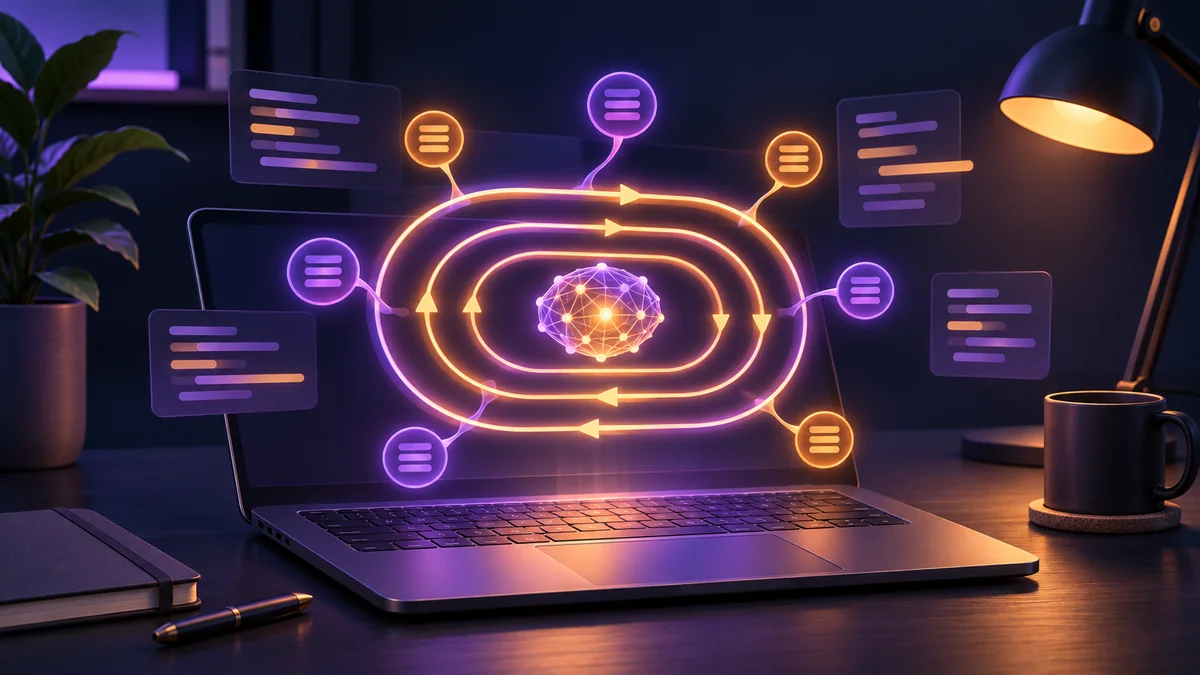
Inkling 2 Mini has 24 layers of weights. The model card says the middle 12 layers run three times with shared weights, so each token goes through 48 layer applications. Hugging Face’s launch post describes it as six layers, then the 12-layer middle block three times, then six more.
Each extra pass through the loop adds about 1.0B effective active parameters, according to the model card. With three passes, that’s where the 5.4B effective active figure comes from, against 3.4B active weights. In each layer, a token is routed to 8 of 128 experts, and attention mixes local and global layers.
Thinking Machines says looping lets the model “apply more reasoning and reach the right answer with fewer tokens,” which matters most on agentic coding. Looping doesn’t add stored knowledge. Thinking Machines says knowledge is mostly a function of total parameter count, so factual recall stays at the level of other models this size.
Thinking Machines also released a research variant, TML-d24-varloop-research, that runs a variable number of loops. The company used it for its chain-of-thought monitorability experiments. It isn’t the model to pick for everyday coding.
Benchmarks, as Thinking Machines reports them
The comparison table in Thinking Machines’ launch post puts Inkling 2 Mini against Gemma 4 31B, Muse Glimmer, Qwen3.8-27B and Nemotron 3.5 Super VL. The main coding rows, with Qwen3.8-27B as the closest rival:
| Benchmark (harness) | Inkling 2 Mini | Qwen3.8-27B |
|---|---|---|
| DeepSWE v1.1 (mini-swe-agent v2.4.6) | 48.2% | 42.2% |
| SWE-bench Pro v2 Hard (mini-swe-agent v2.4.6) | 77.9% | 73.8% |
| FrontierCode v2.0 (stirrup v0.2.1) | 15.1% | 14.9% |
| Terminal Bench v2.1 (pi v0.83.0) | 71.6% | 73.0% |
The pattern matches the company’s own summary: Inkling 2 Mini leads comparable models on agentic coding benchmarks such as DeepSWE v1.1 and SWE-bench Pro v2, and is behind only Qwen3.8-27B on some others. Hugging Face’s team wrote that in its own vibe tests the model is “at least comparable with Qwen 3.8 27B,” and that more validation is needed.
Where Inkling 2 Mini is weaker
Thinking Machines lists the weak spots plainly:
- Multi-turn chat and constraint-heavy instructions. It scores 50.0% on MultiChallenge and 33.4% on ComplexConstraints v1.1, behind Qwen3.8-27B on both.
- Hard reasoning benchmarks. It trails larger models on CritPt v2 and HLE-Diamond.
- Factual recall. Its AA-Omniscience score is in line with other models of its size, because looping doesn’t store more facts.
Thinking Machines says the model makes up for the knowledge gap by using search and tools well, and that it leads similar-size open models on BrowseComp, DeepSearchQA and MCP Atlas. For coding agents, that means it works best with tools for docs and search wired in, not as a model you quiz from memory.
Hardware you need
The model card lists three hardware targets:
- One NVIDIA DGX Spark
- Apple silicon with 32GB or more of memory (MacBooks, Mac minis and Studios)
- Other GPUs and platforms, with 32GB or more of VRAM recommended
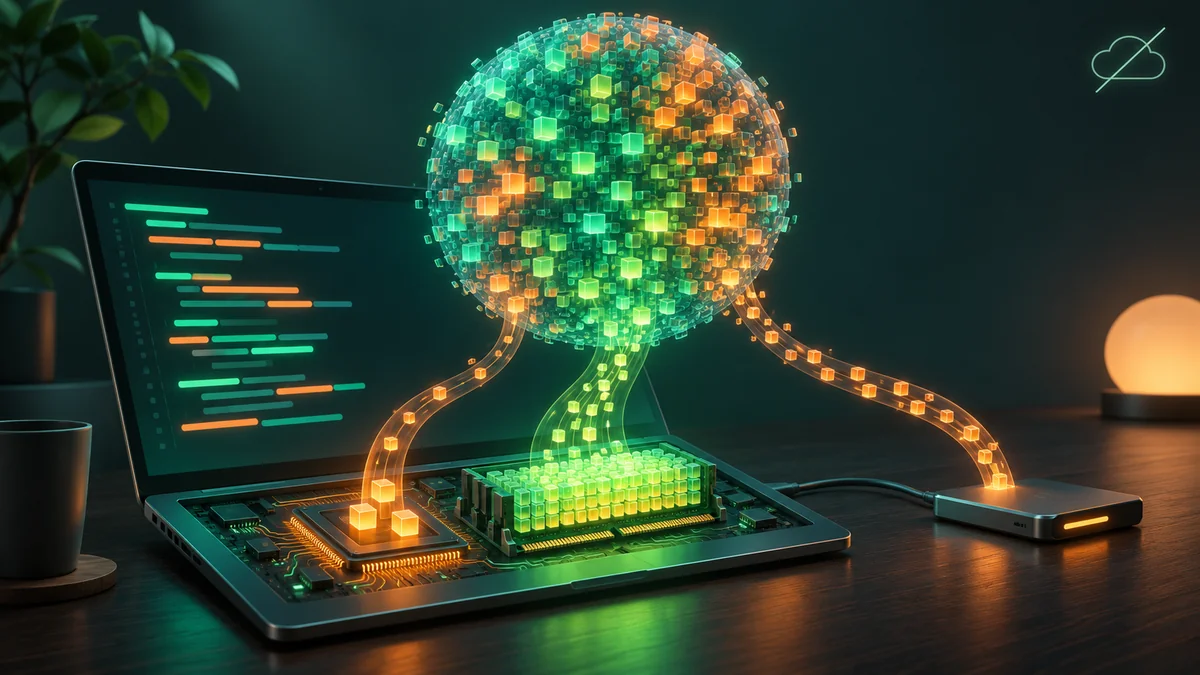
Thinking Machines says most weights were trained and ship natively in NVFP4, with the last four layers in MXFP8, for a total footprint of about 20GB. Its researchers ran the model offline on a MacBook Pro (M5 Pro, 48GB) in airplane mode, where it built a playable flight simulator in a few minutes. That’s a vendor demo, not a benchmark.
A 32GB machine is the floor, not a comfortable target. A long context window needs memory on top of the weights, so plan on using far less than the full 1M tokens on a laptop.
How to run Inkling 2 Mini locally
Thinking Machines lists open-source inference on SGLang, vLLM, Ollama, Unsloth, NVIDIA Dynamo, TokenSpeed and Llama App. Quantized GGUF builds come from Unsloth and llama.cpp. At launch, Thinking Machines says Ollama supports Inkling 2 Mini on any Mac with at least 32GB of RAM.
llama.cpp / Llama App
Hugging Face’s launch post recommends the IQ4_NL GGUF for most users. It converts the original NVFP4 weights to a different 4-bit format, keeps the MXFP8 layers in FP8, and fits in 32GB of GPU RAM or unified memory. On Linux or the command line, the post uses Llama’s one-line installer:
curl -LsSf https://llama.app/install.sh | shRead the script before you pipe it into a shell on a machine you care about. Then start a server compatible with the OpenAI API:
llama serve -hf ggml-org/Inkling-2-Mini-GGUF:IQ4_NLChange the suffix to :Q8_0 for the 8-bit weights. Hugging Face calls Q8_0 near lossless, but it needs more RAM and runs slightly slower. Once the server is up, point an OpenAI-compatible coding agent at it. The Hugging Face post names Pi and ChatGPT Desktop as agents that can use a llama server. Our OpenClaw with Ollama guide covers the same local-endpoint pattern with a different runtime.
vLLM
The Hugging Face model page gives the basic vLLM setup:
pip install vllm
vllm serve "thinkingmachines/Inkling-2-Mini"
That serves an OpenAI-compatible API, and the model page’s example sends requests to http://localhost:8000/v1/chat/completions with thinkingmachines/Inkling-2-Mini as the model name.
SGLang
Hugging Face’s post says SGLang has day-zero support, but its example has a prerequisite: run it on SM103. The post’s speed tests ran on a single NVIDIA B300 GPU, and Hugging Face frames SGLang as the route for production deployments on datacenter hardware, not laptops. The post’s example starts the server with --served-model-name inkling and sends "reasoning_effort": "low" in the request, so the chat API takes a reasoning effort setting.
MLX on a Mac
Hugging Face upstreamed MLX support to the mlx-lm project, including image and text input, and shared quants through the mlx-community organization. MLX can also run the original thinkingmachines/Inkling-2-Mini checkpoint with its native NVFP4 and MXFP8 scheme, without reconversion, so you get the quality the authors shipped. The post’s mlx_lm generate example uses that checkpoint directly.
Before you switch a coding agent to Inkling 2 Mini
- Confirm at least 32GB of unified memory or VRAM, plus headroom for context
- Start with the IQ4_NL GGUF; try Q8_0 only if memory allows
- Give the agent search or documentation tools, since factual recall is the model's weak spot
- Run it on your own repository tasks before trusting the vendor benchmarks
- Keep the local server bound to localhost unless you add authentication in front of it
The last item is our advice, not the vendor’s. A model server with no authentication on a shared network lets anyone send it prompts.
Should you try Inkling 2 Mini?
If you want an offline coding model that fits on a 32GB Mac or a single 32GB GPU, Inkling 2 Mini is one of the strongest options Thinking Machines’ numbers point to, and Apache 2.0 removes most licensing questions. Agentic coding with tools is its strong side.
If your agent spends most of its time in long multi-turn chats, follows dense instruction lists, or answers from memory, the vendor’s own results favor Qwen3.8-27B there. If you have far more memory to spend, our Edge0 145B local coding model post covers a much bigger open model.